

You can build a toddler bedtime routine that actually works by combining predictable structure with choices that let your child feel in control. The secret isn’t a longer routine or more elaborate rituals. It’s understanding that toddlers resist bedtime because they’re developmentally wired to assert independence, not because they’re being difficult. When you design a routine that channels this need for autonomy instead of fighting it, cooperation follows.
I learned this the hard way after months of nightly meltdowns with my daughter. Every expert sleep schedule I tried crumbled within days. The turning point came when I stopped viewing her resistance as defiance and started seeing it through a peaceful parenting lens. Toddlers between 18 months and 3 years are navigating massive cognitive leaps. They understand they’re separate people now, but they lack the emotional regulation to handle that realization smoothly at the end of an exhausting day.
The bedtime routines that fail share common flaws. They’re either too rigid, leaving no room for a toddler’s need to make decisions, or too vague, creating anxiety about what comes next. They also tend to be parent-led rather than collaborative, which triggers power struggles.
What follows is a step-by-step framework built on child development research and real-world testing with families. You’ll learn exactly what materials support the routine, including comfort items like kids dressing gowns which safety considerations matter, how to sequence each step to work with your toddler’s brain rather than against it, and how to verify it’s actually working. This isn’t about perfection. It’s about consistency you can maintain and a structure your toddler will choose to follow.
Why Traditional Bedtime Routines Fail (And What Actually Works)

Your toddler isn’t being difficult when they refuse to go to bed, they’re being developmentally normal. Between 18 months and three years, children are hardwired to assert independence and test boundaries. When we create routines that mirror adult expectations (brush teeth, put on pajamas, get in bed, no discussion), we’re working against their core developmental need: to feel some control over their world.
The traditional bedtime routine fails because it asks toddlers to give up something they want (staying awake with you) without giving them anything in return. Add in separation anxiety, which peaks during toddlerhood, and you’ve got a perfect storm. Your child genuinely doesn’t want you to leave, and unlike adults, toddlers can’t rationalize that you’ll be there in the morning. They live entirely in the present moment.
Here’s what many parents don’t realize: toddlers often can’t identify their own tiredness. They feel cranky, wired, or emotional, but they don’t connect those feelings to needing sleep. Telling an overtired toddler “you’re tired, go to bed” sounds absurd to them. They feel terrible, and you’re trying to separate from them and make them lie down alone. No wonder they fight it.
What actually works is a routine that respects these developmental realities. Instead of a rigid, adult-controlled sequence, think of it as a predictable framework with choice points your toddler controls. They need to know what comes next (predictability reduces anxiety), but they also need to feel like active participants, not passive subjects. When you give a toddler two acceptable choices, red pajamas or blue pajamas, three books or two songs, you’re meeting their autonomy need while still guiding them toward sleep. You’re working with their development, not fighting against it.
What You’ll Need to Set Up Your Routine
The good news? You probably already have most of what you need to create a bedtime routine that works. This isn’t about buying expensive gadgets or transforming your toddler’s room into a sleep sanctuary. It’s about gathering a few key elements that work together to signal sleep time in a way your toddler can recognize and respond to.
Start by thinking about timing. You’ll need to choose a routine start time that’s 30 to 45 minutes before you want your toddler actually asleep. This buffer gives you enough time to move through activities without rushing, which toddlers can sense and resist. A simple kitchen timer or your phone can serve as your transition warning tool, giving that crucial five-minute heads-up before the routine begins.
Here’s what you’ll want to gather:
- Timing tools: A visual timer or regular timer for transition warnings, plus a consistent start time you can maintain nightly
- Environmental setup: Dimmable lights or a small lamp, blackout curtains or shades, a comfortable room temperature around 68-72°F, and any white noise machine if you use one
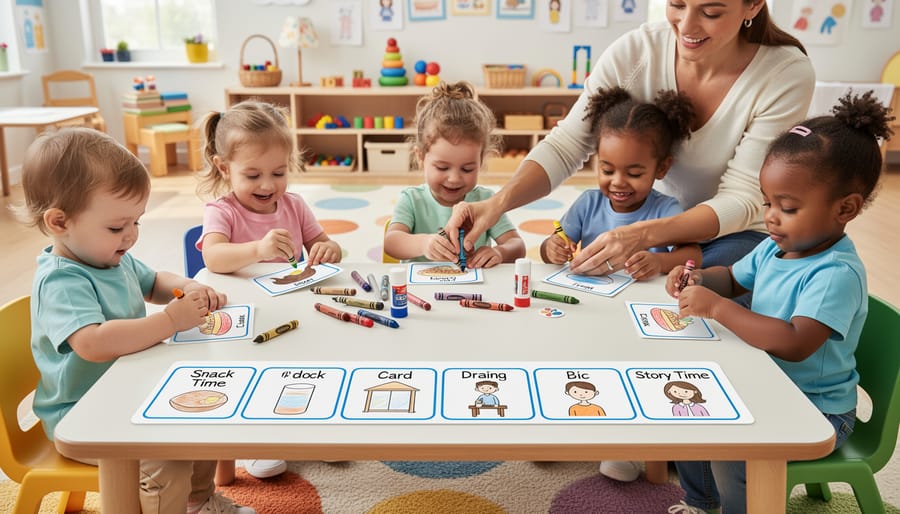
- Visual aids: A simple routine chart with pictures (hand-drawn works perfectly), placed at your toddler’s eye level where they can see and touch it
- Comfort items: Your toddler’s chosen lovey or stuffed animal, their favorite books (two to three is plenty), and comfortable pajamas they can help select
The routine chart deserves special attention because it becomes your toddler’s roadmap. You can create one together using photos of your child doing each step, magazine cutouts, or simple drawings. Laminating it isn’t necessary, but it helps when sticky toddler fingers want to point at each step.
Remember, the most expensive item on this list is your consistency, and that’s free. A loving voice reading the same book in the same spot every night matters infinitely more than a fancy sleep training clock. If you’re missing something, improvise. Dimming the overhead light works as well as a specialty lamp. What matters is creating predictable sensory cues your toddler recognizes as the path to sleep.
Important Considerations Before You Start

Before you dive into building your routine, let’s make sure you’re setting yourself up for success, and keeping your toddler safe.
First, confirm your child’s sleep space meets basic safety standards. The safe sleep room temperature should stay between 68-72°F to prevent overheating. Check that the crib mattress fits snugly with no gaps, or if your toddler has transitioned to a bed, ensure it’s low to the ground with guardrails if needed. Remove pillows, heavy blankets, and any climbable furniture near windows. Scan the room for cords, outlets, and small objects within reach.
Your toddler also needs to be developmentally ready to participate in a routine. Most children around 18 months can follow simple two-step sequences and understand basic visual cues. If your toddler can point to pictures, follow directions like “get your shoes,” and shows awareness of regular daily patterns (like knowing lunch comes after playtime), they’re ready.
Here’s what realistic looks like: Research on nightly bedtime routine timing shows most toddlers need two to three weeks of absolute consistency before the routine clicks. The first week often feels harder than what you’re currently doing. That’s normal, not a sign it’s not working.
Know when to pause or adjust. During illness, teething, or major transitions (new sibling, moving), maintain a simplified version rather than abandoning it entirely. After travel, expect a few rough nights as you re-establish the pattern. And please, start your routine at least 30 minutes before you actually need your toddler asleep, beginning at 7:45 for an 8:00 bedtime sets everyone up for frustration and rushing.
Step-by-Step: Creating Your Toddler’s Bedtime Routine
Step 1: Choose Your Start Time and Sequence
The biggest mistake parents make is starting the bedtime routine too late, when their toddler is already overtired and melting down. Work backward from when you want your child actually asleep. If that’s 7:30 p.m., your routine should start around 6:45 or 7:00 p.m.
Here’s why 30-45 minutes works better than hour-long routines: toddlers have short attention spans, and drawn-out sequences create more opportunities for resistance. Aim for four to six activities, no more. Each should take five to ten minutes.
For an 18-month-old, a simple sequence might look like: bath, diaper and pajamas, two short books, cuddle and song. Three-year-olds can handle slightly more: bathroom routine, pajamas, tidy toys together, three books, talk about the day, lights out.
Notice what’s not in there? Screens, active play, or anything stimulating. Each activity should naturally wind down from the previous one, moving your toddler closer to calm. If you’re currently doing eight steps, cut it down. Shorter routines mean less time for negotiations and fewer chances for things to go sideways.
Step 2: Create Visual Cues Your Toddler Can Follow
Toddlers understand pictures long before they can read a clock or follow abstract instructions. Creating a visual routine chart transforms bedtime from something happening to them into something they can predict and actively participate in.
Start simple: photograph your toddler doing each bedtime step, or draw basic pictures together. Bath time gets a bathtub drawing, brushing teeth gets a toothbrush, pajamas get a little shirt. The act of creating this chart with your toddler, even if they just scribble on it, builds ownership. They’re more likely to follow a routine they helped design.
Hang the chart at your toddler’s eye level, somewhere they pass during the routine. The bathroom or bedroom doorway works well. Before each step, walk to the chart together and point: “What’s next? Oh, pajamas!” Let them move a magnet down the list or put a sticker on the completed step. This physical involvement satisfies their need for control.
Skip fancy laminated versions unless you want them. Printer paper taped to the wall works perfectly. What matters is that your toddler can see what’s coming and mark their progress. That predictability, combined with the satisfaction of completing tasks, is what makes toddlers want to stick with the routine.
Step 3: Build in Toddler-Controlled Choices
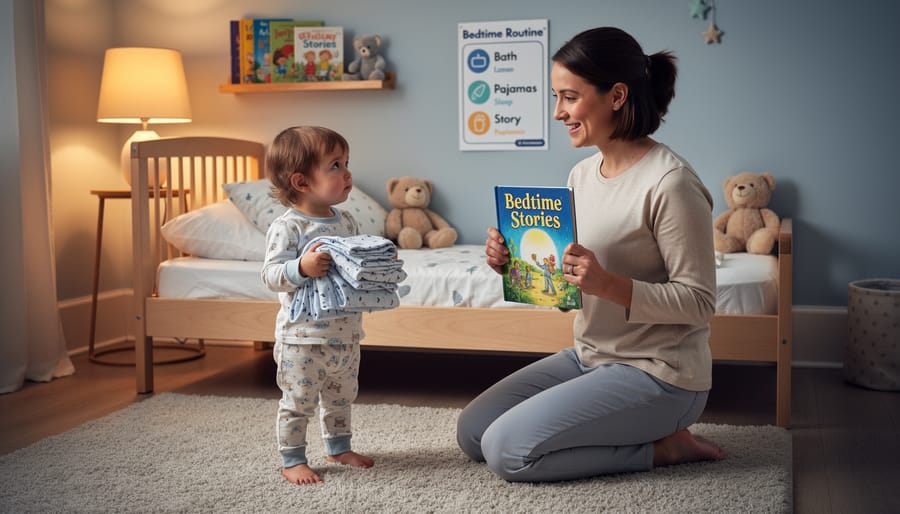
Toddlers crave control, and bedtime is prime territory for power struggles. The secret is offering choices within boundaries you’ve already set.
Use the two-choice method: “Do you want to wear the dinosaur pajamas or the striped ones?” not “What do you want to wear?” Limit every decision to two options you’re genuinely happy with. This works because toddlers feel empowered by choosing, but won’t spiral into decision paralysis or pick something that derails your routine.
Build choice points into three or four spots in your sequence. Which pajamas, which two books from the pre-selected stack, which stuffed animal for bed, red toothbrush or blue. Never offer a choice about whether to do the step itself. It’s not “Do you want to brush teeth?” but “Do you want to brush teeth before or after pajamas?”
When you hand over these small decisions, you’re actually preventing the big battles. Your toddler gets to exercise their growing independence in ways that keep the routine moving forward. They’re a participant, not a prisoner of your schedule, which makes cooperation far more likely.
Step 4: Establish the Transition Signal
Toddlers don’t shift gears the way we do. Their brains need time to process what’s ending and what’s starting, which is why springing “bedtime!” on a playing toddler triggers meltdowns. A transition signal solves this.
Pick one consistent cue you’ll use every night, starting 5-10 minutes before your routine begins. A visual timer works beautifully, toddlers can see the time disappearing. Musical timers, a specific “bedtime song,” or gradually dimming the lights all work too. The key is consistency, not the tool itself.
Your language matters here. Instead of “Bedtime is coming” (which sounds like a threat), try “In five minutes, we’ll start getting cozy for bed” or “The timer will tell us when it’s story time.” This frames the transition as something happening, not something you’re imposing.
Give the same warning the same way every night. When the timer goes off or the song ends, immediately begin step one of your routine without negotiating. Your toddler learns that this signal reliably predicts what happens next, which reduces their need to fight it.
Step 5: Execute the Same Sequence Every Night
The power of your bedtime routine lies in its sameness. Toddlers thrive on predictability, their brains literally relax when they know what’s coming next. Do the exact same activities in the exact same order every single night. Use the same phrases too: “Time to brush those teeth” works better than varying between “Let’s clean your mouth” and “Toothbrush time.”
Both parents should follow the identical sequence. If one caregiver is unavailable, the remaining parent executes the same routine, don’t add or skip steps to compensate. Your toddler will adapt faster when the routine itself stays constant, regardless of who’s leading it.
When your toddler resists (and they will), acknowledge without negotiating: “I know you want to keep playing. It’s bedtime now. Let’s get your pajamas.” Then move forward. Don’t debate, explain extensively, or make deals. Simple acknowledgment of their feelings plus calm follow-through reinforces that the routine isn’t optional.
This consistency feels repetitive to you, but it’s precisely what makes toddlers feel secure enough to cooperate.
Step 6: End with Connection, Not Compliance
The last minute before lights out isn’t about getting your toddler to comply, it’s about connection. This brief moment of closeness makes separation feel safe, which actually reduces resistance.
Choose one connection activity and keep it to 2-3 minutes maximum. Effective options include a specific cuddle position you only do at bedtime, singing the same lullaby, or asking “what made you happy today?” This predictable ritual becomes an anchor, one of those small relationship habits that strengthen your bond while signaling the day is ending.
The key is making it genuinely warm without negotiable. Say something like: “Now it’s our special cuddle time, then sleep time for your body.” Stay present, put your phone down, make eye contact, offer your full attention for these moments.
When the time is up, use your final goodnight script every single night: “I love you. Your room is safe. I’ll see you in the morning. Goodnight.” Then leave calmly, even if they protest.
If your toddler asks for “one more,” acknowledge the feeling without reopening negotiations: “I know you want more time. We had our cuddle. Now it’s sleep time.” Your calm consistency here teaches that bedtime is final but still loving, not a battle to win.
How to Tell If Your Routine Is Working (And When to Adjust)
You won’t see overnight transformation, and that’s completely normal. Real progress shows up gradually, and knowing what to look for helps you stay the course when doubt creeps in.
After one week of consistency, you might notice subtle shifts. Your toddler may protest less when you give the transition warning, or they might remember what comes next in the sequence without prompting. These small wins matter more than perfect compliance. If bedtime is taking roughly the same amount of time but with slightly less drama, you’re moving in the right direction.
By two weeks, most toddlers start showing clearer signs of acceptance. They might grab their routine chart without being asked or announce “bath time!” when they see you dimming the lights. The number of curtain calls usually drops, and the intensity of resistance softens. Instead of full meltdowns, you might get brief protests followed by cooperation.
At the one-month mark, success looks like your toddler anticipating and sometimes initiating routine steps. They settle faster once in bed, and you’re spending less emotional energy managing resistance. Some toddlers will independently complete parts of the routine, like fetching pajamas or choosing books. Not every night will be smooth, but the hard nights become exceptions rather than the rule.
Watch for these signs that indicate whether your routine is working:
- Your toddler protests less at the transition warning and accepts that bedtime is approaching
- They remember sequence steps without constant rempting or start doing parts independently
- Time from routine start to lights out shortens as efficiency improves
- Requests for water, bathroom trips, and “one more” pleas decrease noticeably
- Your child appears calmer during the routine instead of ramping up energy
Red flags signal you need to adjust. If tantrums intensify after two consistent weeks, your routine may be too long or starting too late when overtiredness has already set in. New sleep problems like night waking or early rising that didn’t exist before suggest timing issues. Extreme resistance that increases rather than decreases means something in your sequence isn’t working for your specific child.
When problems arise, simplify first. Cut one or two steps from the sequence and see if shorter works better. If your toddler melts down at the same point every night, that specific activity might be overstimulating or under-satisfying. Swap it for something calmer or more connective. Sometimes moving the start time fifteen minutes earlier solves everything because you’ve been missing the sleep window.
As your toddler grows, expect to adjust. The routine that works beautifully at two may need tweaking at two and a half when language skills and autonomy drives surge. Add more choice points for older toddlers, extend connection time slightly if separation anxiety flares during developmental leaps, or shift timing as sleep needs change. The framework stays consistent while the details flex with your child’s evolution.
Common Roadblocks and How to Overcome Them
Even with the best-laid plans, toddler bedtime rarely goes perfectly every night. Here’s how to handle the most common challenges without abandoning your routine.
The Jack-in-the-Box Toddler
If your child keeps getting out of bed, resist the urge to engage. The first exit gets a calm, neutral walk-back with minimal words: “It’s bedtime. Back to bed.” No conversation, no eye contact beyond safety checks. Each subsequent exit gets even less reaction, just a gentle redirect. This feels endless for the first few nights, but consistency breaks the pattern. Some parents find success with a gate in the doorway (so toddler can see out but not roam) during this transition phase.
The Endless Requests
Water. Another hug. One more story. Bathroom. These delay tactics are genius-level toddlering. Prevent them by front-loading the routine: offer water as a routine step, do an extra-long hug before lights out, allow two bathroom trips. Then, when requests come after the final goodnight, you can truthfully say “We already did that.” Acknowledge the feeling without complying: “I know you want more water. We had our bedtime drink. I’ll see you in the morning.”
Routine Regression
Your routine was working beautifully, then suddenly it’s chaos again. This often coincides with developmental leaps, illness recovery, or big life changes. Don’t scrap the routine, return to basics. Simplify if needed (fewer steps, earlier start time), increase connection time during the day, and ride it out. These regressions typically last one to two weeks if you maintain consistency. For broader sleep tips during difficult phases, remember that toddler sleep is rarely linear.
Weekend Disruption
Late dinners and relaxed schedules feel great until Monday arrives. Try to keep bedtime within 30 minutes of the weekday routine, even on weekends. If you have a late event, do an abbreviated version of the routine rather than skipping it entirely. The sequence matters more than the clock time.
Managing Multiple Children
Stagger routines by 15-30 minutes if possible, with the younger child going first. Older siblings can have quiet independent time (books, puzzles) while you settle the toddler. Some families do shared routine elements (bath time, stories) then separate for the final wind-down. Whatever you choose, each child needs their own brief one-on-one moment before sleep.
Frequently Asked Questions
What age should I start a bedtime routine with my toddler?
You can introduce simple bedtime routines as early as 12 months, but most toddlers begin actively participating around 18-24 months when they understand sequencing and can follow two-step directions. Younger toddlers benefit from shorter routines (3-4 steps), while older toddlers (2.5-3 years) can handle the full 4-6 step sequence.
My toddler’s routine worked great, then suddenly stopped working. What happened?
Regression is completely normal and usually signals a developmental leap, illness recovery, or routine disruption like when you travel with toddlers. Return to basics by simplifying the routine temporarily, re-establishing consistency, and being patient, it typically takes 3-5 days to get back on track rather than the initial 2-3 weeks.
How do I handle bedtime routine when my partner isn’t home?
The routine itself should stay identical regardless of which parent leads it, same order, same activities, same language. If your toddler protests the ‘wrong’ parent, acknowledge their feelings (“I know you want Daddy tonight”) without negotiating, then calmly proceed with the routine exactly as planned.
Should bedtime be the exact same time every night?
Aim for consistency within a 30-minute window rather than rigid precision. A routine that starts between 7:00-7:30 pm works better than one that’s exactly 7:00 pm but gets derailed by life, and toddlers’ internal clocks adapt to the predictable pattern rather than the exact minute.
What if my toddler refuses to participate in the routine?
Resistance in the first two weeks is expected as your toddler tests the new structure. Stay calm and matter-of-fact, offering choices within the routine (“Do you want to brush teeth before or after pajamas?”) rather than whether to do the routine at all. If refusal persists beyond three weeks, the routine may be too long or starting too late when your toddler is overtired.
Can I adjust the routine on weekends or special occasions?
Occasional flexibility won’t derail an established routine, but aim to keep at least the core sequence intact even if timing shifts slightly. The key is returning to the regular pattern the next night without guilt or over-explanation, toddlers adjust quickly when consistency is the norm, not the exception.
These questions reflect the real concerns parents encounter once they’ve built their routine and are living with it day to day. Remember that questions are normal, adjustments are part of the process, and every family’s routine looks slightly different based on their toddler’s temperament and household rhythm. What matters most isn’t perfection in execution but your willingness to stay consistent even when it feels hard. Trust that the investment you’re making now in establishing healthy sleep patterns will pay dividends in calmer evenings and better rest for everyone.
You’re doing hard, meaningful work. Building a bedtime routine that actually sticks takes patience, and those first few weeks can feel exhausting when you’re met with resistance despite your best efforts. But here’s what I want you to remember: consistency really does pay off. Most families see genuine improvement within two to three weeks, and the peace that follows is worth every challenging night you push through right now.
There will be setbacks. A growth spurt, a cold, or even just a random Tuesday might throw everything off, and that’s completely normal. Adjusting the routine doesn’t mean you failed. It means you’re responding to your child’s changing needs, which is exactly what good parenting looks like. Some toddlers need more transition time, others need fewer steps, and yours might need something entirely unique to them. That’s okay.
No article, expert, or perfect routine chart knows your child the way you do. You’ve already learned their patterns, their triggers, and what soothes them. Trust that knowledge. Trust that the small, consistent steps you’re taking now are building security and healthy sleep habits that will serve your whole family.
The bedtime battles won’t last forever. Keep showing up with patience and structure, and you’ll get there. You’re giving your toddler something incredibly valuable: the gift of knowing what to expect, and the comfort of a parent who stays steady through the storms.